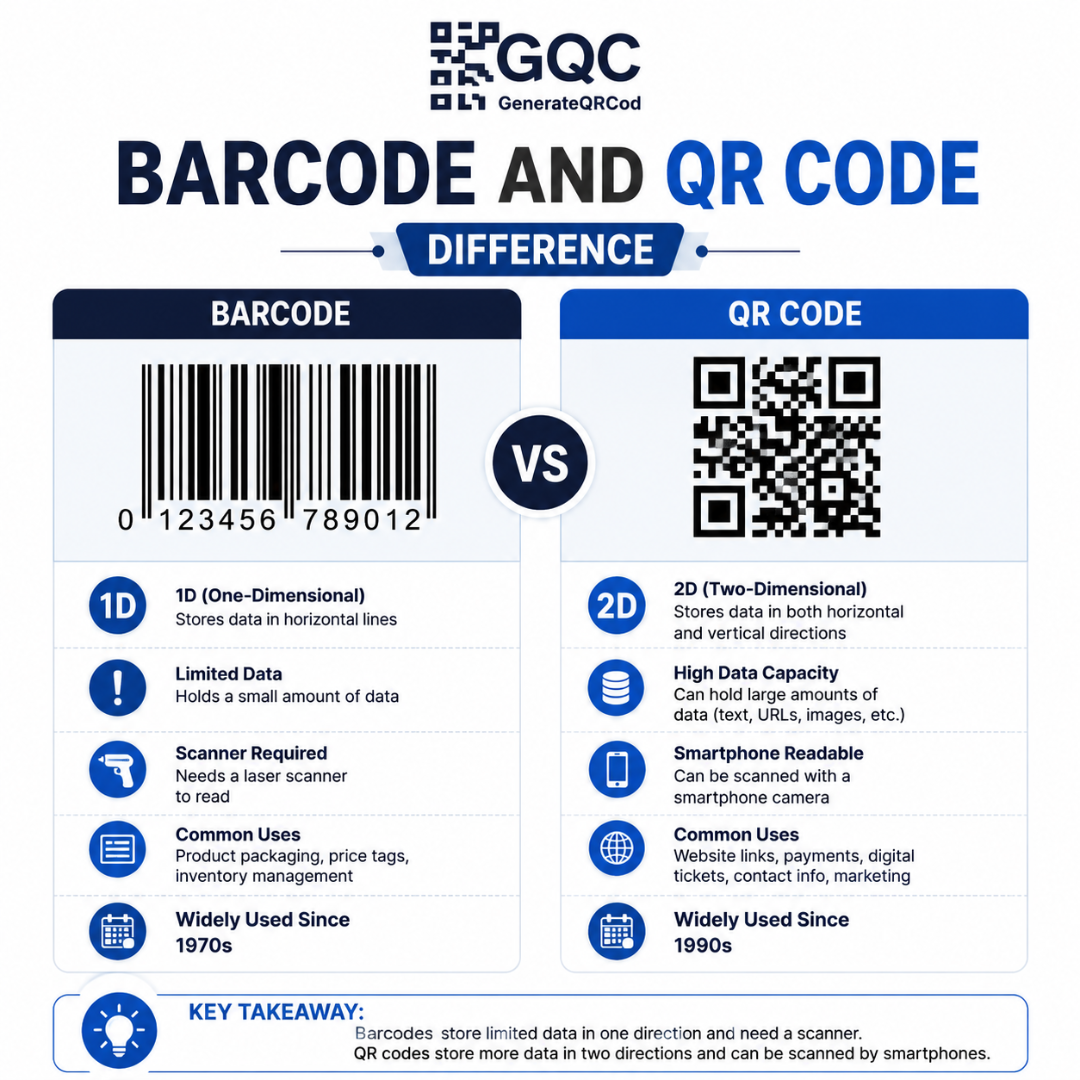
If you have ever scanned a product at a grocery store or used your phone to access a website, you have used either a barcode or a QR code. But do you know the barcode and QR code differences? Both are popular scanning technologies, yet they work quite differently and serve different purposes. In this article, we break down everything you need to know about these two tools so you can decide which one best fits your needs.
What Is a Barcode?
A barcode is a one-dimensional (1D) optical label that stores data in a series of parallel black and white lines. When a scanner reads those lines, it decodes the information, usually a product number or price. Barcodes have been around since the 1970s and are still widely used in retail, logistics, and warehousing.
The most common type is the UPC (Universal Product Code), found on almost every packaged product in supermarkets worldwide. Other formats include EAN, Code 39, and Code 128.
What Is a QR Code?
A QR code, or Quick Response code, is a two-dimensional (2D) matrix barcode invented in Japan in 1994. Unlike a standard barcode, a QR code stores information both horizontally and vertically. This means it can hold much more data, including URLs, text, contact details, and even Wi-Fi credentials.
QR codes became mainstream with the rise of smartphones. Today, you find them on restaurant menus, business cards, payment apps, and marketing materials.
Barcode and QR Code Difference: A Side-by-Side Comparison
Here is a clear comparison table to help you understand the key differences:
Feature | Barcode (1D) | QR Code (2D) |
Dimensions | One-dimensional | Two-dimensional |
Data Capacity | Up to ~20 characters | Up to 7,089 characters |
Data Type | Numbers only (mostly) | Text, URL, numbers, binary |
Scan Direction | Horizontal only | Any direction |
Error Correction | None | Up to 30% damage recovery |
Readability | Requires barcode scanner | Smartphone camera works |
Use Cases | Retail, inventory | Marketing, payments, info sharing |
Size Requirement | Needs more space | Can be very small |
Printing Cost | Low | Low to medium |
Key Differences Between Barcode and QR Code
1. Data Storage Capacity
This is the biggest barcode and QR code difference. A traditional barcode holds very limited data, usually just a numeric product code. A QR code can store thousands of characters including links, emails, and multimedia instructions. For modern marketing and digital use, QR codes win by a wide margin.
2. Scanning Technology
Barcodes need a dedicated laser scanner, such as the ones at supermarket checkouts. QR codes can be scanned with any modern smartphone camera, no special hardware required. This makes QR codes far more accessible for everyday consumers.
3. Error Correction
QR codes have built-in error correction. Even if part of the code is torn, smudged, or covered, the scanner can still read it accurately. Barcodes offer no such resilience. One smudge can make a barcode unreadable.
4. Use Cases and Applications
Barcodes are ideal for simple inventory tracking and point-of-sale systems. QR codes serve a broader purpose: website links, contactless payments, event tickets, business cards, and more. As digital transformation grows, QR codes are becoming the preferred choice.
Benefits of QR Codes Over Traditional Barcodes
• Store more data in less space
• Work with smartphones, no scanner needed
• Support URLs, contact info, Wi-Fi logins, and more
• Offer error correction for damaged codes
• Easy to create and print for free
• Support custom designs and branding
When Should You Use a Barcode vs. a QR Code?
Use a barcode when you need simple product identification in a retail or warehouse setting and you already have compatible scanners in place. Use a QR code when you want customers to access information quickly with their phones, especially for marketing, menus, payments, or digital content.
For new projects and consumer-facing applications, QR codes are almost always the better choice.
Common Mistakes People Make
• Assuming barcodes and QR codes do the same job
• Using a barcode where a QR code would offer much more value
• Creating QR codes that are too small to scan
• Forgetting to test the QR code before printing it at scale
• Not choosing the right error correction level for outdoor or high-wear use
Tips for Choosing the Right Code
• For simple retail inventory: stick with barcodes
• For customer engagement and marketing: go with QR codes
• If your audience uses smartphones frequently: QR codes are the obvious pick
• If you need durability outdoors, choose QR codes with high error correction
Conclusion
Understanding the barcode and QR code differences helps you make smarter choices for your business or personal needs. While barcodes remain useful for simple inventory tasks, QR codes offer far more versatility, capacity, and consumer-friendliness. As the world moves further into digital experiences, QR codes are clearly the technology of the future.
Ready to create your own QR code? Try a free QR code generator online and get started in seconds. Internal link suggestion: Link to your article on the best free QR code generators. Another internal link opportunity: Link to your article on QR code benefits for business.