A “For Sale” board does one job well. It tells people the house is for sale. After that, it is basically decoration.
Think about the buyer standing on the footpath at 8 on a Sunday evening. Interested. Curious about the price. Not going to call an agent at that hour, not going to note down a ten-digit number, and definitely not going to remember your name by Monday morning. That is a lead you already paid for, walking away.
QR codes for real estate agents fix that gap. A QR code is a scannable square you print on signage, flyers, business cards or ads, which opens a property listing, a virtual tour, an enquiry form or a direct call link. It turns printed marketing into something clickable — and it tells you which board or brochure actually produced the enquiry. You can make one in a minute with a free QR code generator.
Here are twelve places to use them, ranked roughly by how quickly they pay off.
Why do QR codes work so well in real estate?
Property is one of the few products people shop for physically before they shop online. Buyers drive through neighbourhoods, walk past boards, and pick up flyers at open houses. A QR code captures that interest at the exact moment it peaks, instead of hoping the buyer remembers to search for the listing three days later.
And most of that interest happens outside office hours. Evenings. Weekends. Which is precisely when nobody is answering your desk phone.
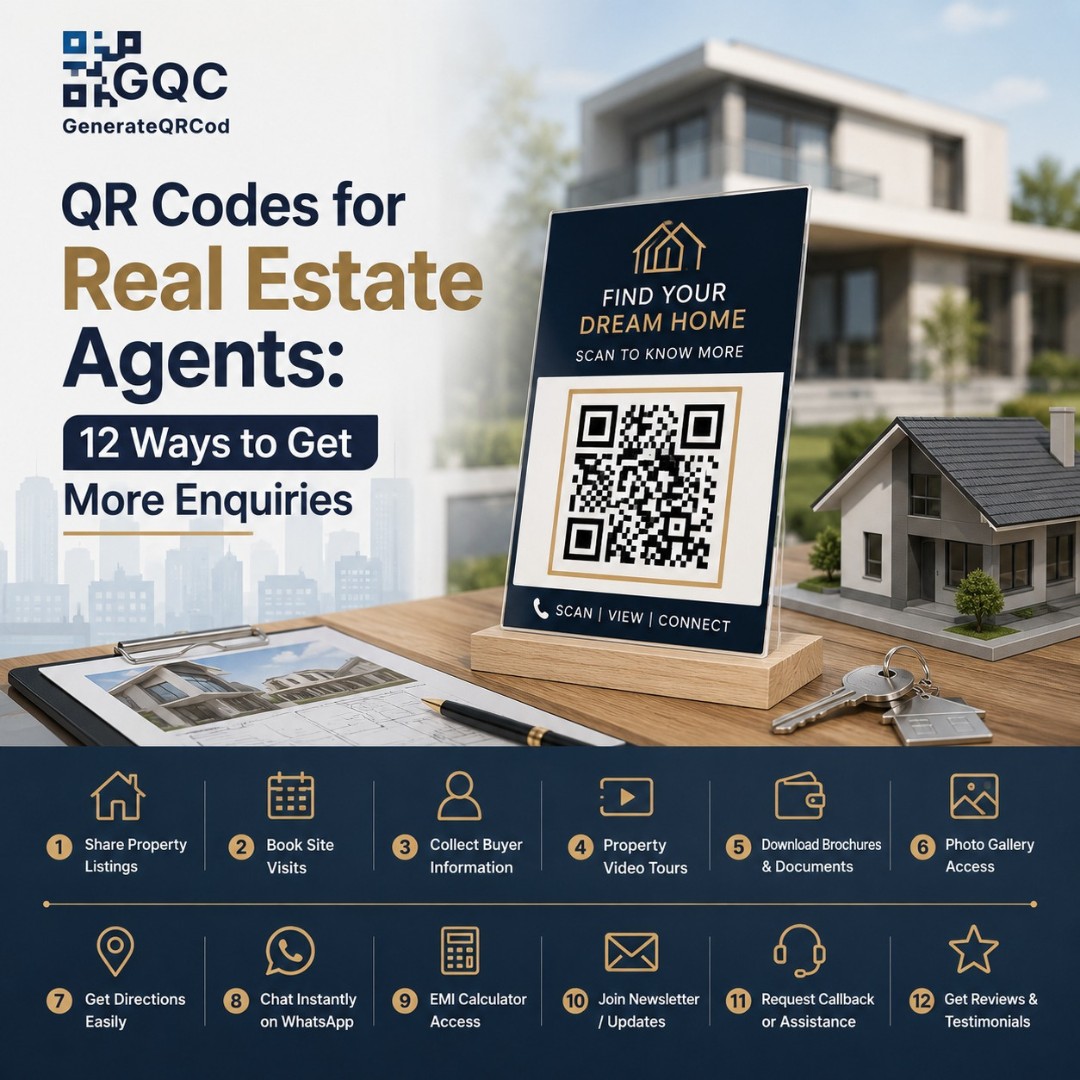
12 ways real estate agents use QR codes to get more enquiries
1. On the “For Sale” board or yard sign
The highest-value spot, easily. Link it straight to that property’s listing page — full photo gallery, price, floor plan, and an enquiry form. Not your homepage. The exact listing.
Add a prompt beside the code: “Scan for photos, price & floor plan”
2. In the office window display
Your window works 24 hours. Your staff do not. Print a QR beside each listing card so passers-by can browse the full gallery on their phone at 10pm, and send an enquiry that lands in your inbox before you open.
3. Open house sign-in, without the clipboard
Clipboards produce handwriting nobody can read and email addresses that bounce. A QR at the entrance that opens a short form gets you clean, typed, verified contact details — and visitors move through the door faster.
4. Virtual tours and video walkthroughs
Link the code to a 360-degree tour or a two-minute walkthrough video. Buyers standing outside get to see the interiors immediately. Out-of-town buyers get a real feel for the property before booking a visit.
5. Property brochures and flyers
A flyer holds maybe six photos. The listing page holds forty, plus the floor plan, plus the location map. One QR code closes that gap without a bigger print budget.
6. Your business card as a vCard
A vCard QR code saves your name, phone, email, agency and website into the buyer’s contacts with one scan. No typing, no typos, no card lost in a jacket pocket. It also means your number is in their phone when they are ready — which in real estate might be next March.
7. Tap-to-call codes on signage
A phone-type QR code opens the dialler with your number pre-filled. One scan, one tap, the phone rings. It is the shortest possible route from kerbside interest to a live conversation.
8. Pre-written WhatsApp or SMS enquiries
This one is underused and it converts. An SMS QR code opens a message already written: “Hi, I saw the board at 12 Park Lane and I’d like the details.” The buyer only has to hit send. You get the enquiry along with the property reference already attached.
9. Google review requests after closing
Reviews are how the next client finds you. Put a QR on your closing folder, your thank-you card, or the gift you hand over at possession — linked directly to your Google review form. Ask while the relief and happiness are fresh.
10. Newspaper ads, hoardings and bus shelters
Print advertising has always had the same problem: you cannot measure it. A QR code with a tracking tag on the link finally tells you whether that half-page ad brought in nine enquiries or none.
11. “Just Listed” and “Just Sold” postcards
When you farm a neighbourhood, the real target is not the buyer — it is the neighbour thinking about selling. Link the QR to a free home valuation form instead of the listing. Different code, different landing page, much better lead.
12. Floor plans, legal documents and EMI calculators
Serious buyers want documents. A QR code linked to a PDF gives them the floor plan, the approval papers or the payment schedule without an email chain. And a code linked to a loan calculator quietly moves them from “nice house” to “I could afford this.”
What size should a real estate QR code be?
Use the divide-by-ten rule: the QR code should be at least one-tenth the size of the distance it will be scanned from. A code scanned from two metres needs to be roughly 20 cm wide. Get this wrong on a yard sign and the code is decorative, not functional.
Where it is placed | Typical scan distance | Minimum QR size |
|---|---|---|
Business card | 20 – 30 cm | 2 cm |
Flyer or brochure | 30 cm | 2.5 cm |
Office window display | 1 metre | 8 – 10 cm |
“For Sale” board / yard sign | 2 – 3 metres | 20 – 30 cm |
Hoarding or billboard | 10 metres and beyond | 80 cm and up |
Five mistakes that kill real estate QR codes
Mistake | What actually happens | Fix |
|---|---|---|
Code too small on a board | Nobody can scan it from the road | Use the divide-by-ten rule |
Linking to the homepage | Buyer has to hunt for the property and gives up | Link to the exact listing URL |
Landing page not mobile-friendly | Every scan happens on a phone — they bounce | Test the page on a phone before printing |
No instruction next to the code | People do not know what they will get | Add “Scan for photos & price” |
One code across every campaign | You never learn what worked | Separate codes or tracking tags per channel |
How to track which QR code brought the enquiry
This is where QR codes stop being a gimmick and start being a marketing tool. Add tracking parameters to the link before you generate the code, then read the results in Google Analytics.
yoursite.com/listings/12-park-lane?utm_source=qr&utm_medium=yard-sign&utm_campaign=park-lane
Change the medium for each channel — yard-sign, flyer, window, postcard, newspaper. After a month you will know exactly which piece of print earns its cost and which one you should quietly stop paying for.
One code per property, per channel. Not one code for everything.
Keep a simple sheet mapping each code to its listing and campaign.
Check scans against enquiries — high scans with low enquiries usually means a weak landing page, not a weak sign.
How to create a real estate QR code for free
Decide the destination first — listing page, virtual tour, enquiry form, or your vCard.
Add your tracking parameters to the URL.
Open a custom QR code generator online and pick the type you need: URL, vCard, phone, or SMS.
Paste the link, set your brand colours, and drop your agency logo in the centre using the QR code generator with logo option. Keep error correction on High.
Download SVG for print and PNG for digital. SVG will not blur when your printer scales it up to yard-sign size.
Print one test copy. Scan it from the actual distance a buyer would stand. Then order the full run.
Start with one board this week
Do not roll this out across the whole agency at once. Pick your busiest listing, put a properly sized code on that board linking to the listing page, and give it thirty days. Watch the scan numbers. Then decide where the second one goes.
Create your first property QR code with the best free QR code generator online — URL, vCard, phone and SMS codes, your logo in the centre, print-ready SVG download. No sign-up, no watermark, no limits.